BLOG Building Bridges in the Nor......

BLOG Building Bridges in the Nor......
BLOG Building Bridges in the Nor...
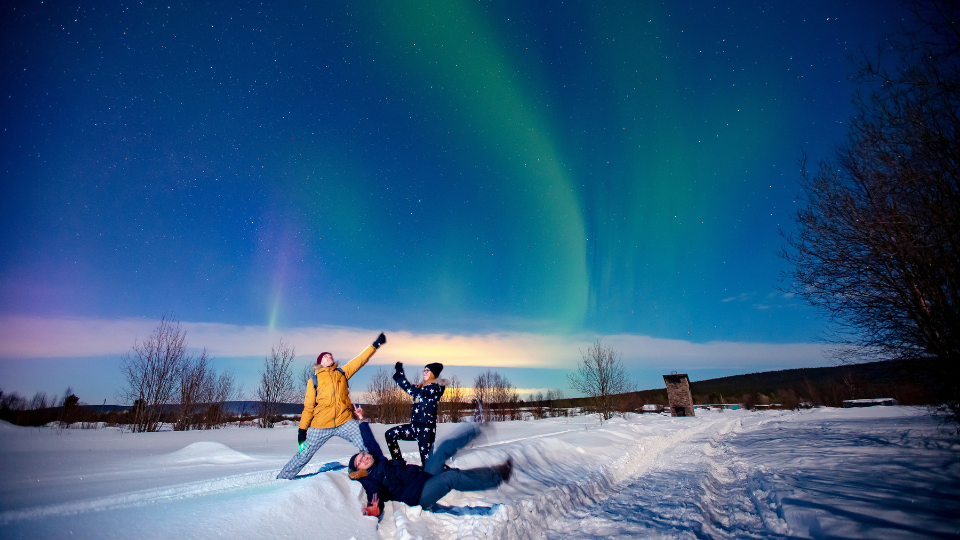
Imagine you are about to step into a hole in the ice to pitch your business idea to a global audience. You close your eyes for a moment to brace yourself, and your mind starts racing: What if I lose my words when the freezing water hits me? How do I move forward when every part of me wants to stay put?
This moment probably feels very familiar to anyone interested in building a company. It demands courage to recognize opportunity even on the iciest stage, clarity to shape your message, and creativity to make your pitch memorable. But above all, it requires the ability to move forward despite uncertainty.
An entrepreneur in the Nordic Arctic knows uncertainty well, and adapting to shifting circumstances is simply part of the job. In the northernmost regions of Finland, Norway, and Sweden, entrepreneurship is shaped by conditions few others face: talent drain, limited infstructure, long distances, connectivity issues, and scarce resources. Here, darkness, distance, and delays are not unexpected challenges — they’re part of the operating manual.
To thrive, or even survive, in the harsh conditions of the Arctic, Nordic entrepreneurs rely on resilience. And resilience is often strengthened through collaboration. As Kelley and Kelley note in Creative Confidence (2013), resilient people are more likely to seek help, draw on strong social networks, and stay connected with colleagues, friends, and family. In the North, even reindeer understand the power of moving together. Entrepreneurs don’t collaborate because it’s fashionable; they collaborate because in this environment, isolation is costly or even dangerous.
The challenges of the Nordic Arctic can’t be solved alone. They require shared expertise, shared responsibility, and shared learning. Cross-border collaboration expands the pool of resources, accelerates innovation, and deepens cultural understanding. It also strengthens resilience across the region. By integrating Indigenous knowledge and local perspectives, innovation becomes not only more effective but also more sustainable and rooted in northern realities.
This is where the ELSA project (Engaging Learning for Sustainable Arctic) comes in. Coordinated by Oulu University of Applied Sciences, ELSA shows how collaboration can actively shape the future of entrepreneurship in the north.
ELSA brings together partners across national, cultural, and disciplinary borders to design lifelong learning opportunities tailored to Arctic conditions. The project develops new innovation and entrepreneurship courses in collaboration with local companies, uses distance learning to overcome long distances, and integrates indigenous and regional knowledge into entrepreneurial education. The goal is simple but ambitious: to make learning relevant, accessible, and grounded in northern realities.
The future of the Nordic Arctic will be built together. When young people are supported, when universities and businesses work side by side, and when borders become meeting points instead of barriers, new ideas, jobs, and innovations can flourish.
The ELSA team believes that borders can function as connectors, and that collaboration is the bridge that enables northern entrepreneurs to thrive.
Lately, I’ve thought a lot about courage, which is essential when embarking on an entrepreneurial journey. You need courage to try out new ideas, to make decisions in circumstances that are far from certain, and courage to do things differently than before. At universities of applied sciences, we can teach business models, marketing, and finance, but how do we teach courage?
ELSA approaches innovation and entrepreneurship through practical, active, and experiential learning in an international and interdisciplinary community. Alongside entrepreneurial and innovation skills, the upcoming study modules designed and piloted by ELSA will explore, for example, human-centered design, cross-border collaboration and practices, creative self-confidence, and other themes essential for success in the northern context.
Let’s go back to the moment of stepping into the icy water. Opening your eyes and taking in your surroundings is the first step. It takes courage not to turn away. Courage isn’t the absence of fear; it’s about moving forward even when staying put feels safer. But in the Northern Arctic, the real risk is not the cold. It’s standing still.
So take one small step. Then the next. That’s how Arctic entrepreneurs move forward. That’s how Nordic Arctic collaboration begins.
ELSA project (2025-2028) is funded by Interreg Aurora, The Norwegian Barents Secretariat, Troms fylkeskommune, and The Regional Council of Lapland. Project partners: Oulu University of Applied Sciences, University of Lapland, UiT The Arctic University of Norway and Sor-Varanger Utvikling through Ost-Finnmark Kunnskapssenter.